
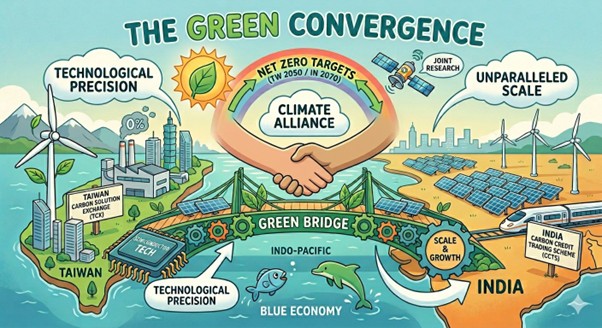
By Dr. Kailas Deoram Ahire (AI Generated Image)
In the context of the accelerating climate crisis, 2026 represents a pivotal juncture for two of Asia’s most dynamic economies: Taiwan and India. Despite differences in geography and scale, both countries are navigating the complex transition from fossil-fuel dependence to green resilience. Taiwan is targeting Net Zero emissions by 2050, while India has set a goal for 2070. The transition is increasingly characterized by collaboration rather than isolated national efforts. This shift is driven by a shared understanding that traditional energy paradigms are inadequate for addressing the challenges of a warming planet and a rapidly evolving global market. Taiwan, recognized for its high-tech manufacturing sector, is expanding offshore wind capacity and integrating advanced smart-grid technologies to stabilize its energy-intensive semiconductor industry. Concurrently, India is utilizing its vast landmass and solar potential to position itself as a global hub for green hydrogen and affordable photovoltaic energy.
The synergy between Taiwan and India is rooted in the combination of Taiwan’s precision engineering capabilities and India’s large-scale market. As Taiwan seeks to diversify its supply chains and invest in sustainable infrastructure internationally, India provides a promising environment for “Make in India” green initiatives. By 2026, this partnership has evolved beyond bilateral trade into a strategic alliance centered on circular economy principles, battery storage innovation, and the decarbonization of heavy industry. Addressing the geopolitical and logistical challenges of this transition requires more than policy adjustments; it necessitates coordinated efforts to harmonize regulatory frameworks and promote research and development resilient to the uncertainties of the mid-21st century. The success of these two distinct yet interconnected economies may serve as a model for leveraging technical expertise and demographic scale to combat environmental degradation.
The Architecture of Ambition: Emissions Trading Systems and Carbon Pricing:
A significant area for collaboration is the development of carbon markets. Taiwan plans to pilot its Emissions Trading System (TW-ETS) by the end of 2026, building on the foundation established by the Taiwan Carbon Solution Exchange (TCX). At the same time, India is advancing its own Carbon Credit Trading Scheme (CCTS).
This collaboration presents two primary opportunities:
Standardization: Aligning carbon accounting standards would enable Taiwan and India to ensure that green investments in India, such as large-scale solar farms or reforestation projects, generate high-integrity credits recognized by Taiwanese firms subject to domestic carbon fees. Such harmonization reduces the risk of “greenwashing” and guarantees that a ton of carbon offset in the Thar Desert is valued equivalently in the science parks of Hsinchu.
Market Liquidity: Establishing a “Green Corridor” for carbon credit exchange could provide the financial liquidity necessary for India’s industrial decarbonization. This mechanism would offer Taiwanese semiconductor and manufacturing firms, which are often land-constrained and energy-intensive, access to a diverse, high-volume portfolio for offsetting unavoidable emissions, while channelling essential capital into Indian sustainability startups.
Semiconductor and Solar Sector Synergy:
Taiwan played a leading role in the “Hardware Revolution” of the 20th century through its silicon manufacturing, and is now positioned to drive the “Green Revolution” of the 21st century through systems integration. India has recently introduced strict localization requirements for solar components, mandating domestic production of wafers and ingots by 2028. This development signals significant opportunities for Taiwan’s advanced manufacturing sector, which holds the intellectual property necessary to establish these complex value chains.
Taiwan’s expertise in smart grids, IoT-enabled energy management, and high-efficiency solar cells aligns with India’s need to achieve its ambitious target of 500 GW of non-fossil capacity by 2030. Conversely, India offers the large-scale environment necessary for Taiwan to refine its climate technology innovations. For example, testing a microgrid in a rural Indian village provides a data-rich environment for an extensive test that Taiwan’s compact geography cannot offer, facilitating rapid scaling of innovations prior to global export.
Resilience Beyond Industry: Agriculture and Marine Ecosystems:
Climate policy extends beyond industrial concerns to encompass broader issues of survival. Both Taiwan and India face existential threats from rising sea levels and erratic monsoon patterns. Taiwan’s advancements in precision agriculture, including satellite monitoring, AI sensors, and drought-resistant seed technology, can support India’s extensive agricultural sector in adapting to increasingly unpredictable water scarcity.
In 2026, both nations are making significant investments in Blue Carbon initiatives, such as mangrove and coral restoration. This creates a strategic opportunity for a “Western Pacific-Indian Ocean Climate Pact.” Collaborative research on marine heatwaves and coastal protection would safeguard biodiversity and secure food chains that support over 1.4 billion people. Protecting the “lungs of the ocean” is a shared imperative that transcends traditional geopolitical boundaries.
A Roadmap for 2026 and beyond is to translate this potential into policy, both governments may consider three immediate and actionable steps:
- Establish a Track-II Climate Dialogue: Facilitate collaboration by enabling research institutes and private sector forums to develop shared technical standards for green hydrogen and battery storage, thereby bypassing formal diplomatic obstacles.
- Joint Green Bonds: Co-issue “Blue-Green Bonds” to finance coastal resilience projects. This approach would leverage Taiwanese financial capital and technological oversight to mitigate risks for projects in India, establishing a model for cross-border climate finance.
- Talent Exchange: Introduce a “Green Tech Visa” to enable Indian engineers and Taiwanese environmental scientists to work seamlessly across borders. This exchange of human capital ensures that expertise for the energy transition is shared rather than isolated.
The climate crisis transcends national borders, necessitating solutions that do the same. Bridging the gap between Taiwan’s technological precision and India’s large-scale capacity can provide a model for “Global South-Global North” cooperation. In 2026, the establishment of a Green Bridge is not a luxury but a necessity for achieving a sustainable Asian century.
About the Author: Dr. Kailas Deoram Ahire is a visiting fellow at National Taiwan University in Taipei and is affiliated with Taiwan’s Ministry of Foreign Affairs. He is also an assistant professor in the Department of Environmental Science at K.R.T. Arts, B.H. Commerce, and A.M. Science (KTHM) College in Nashik, Maharashtra, India.