
By KHT Staff
KAOHSIUNG — An alternative proposal for extending Taiwan High Speed Rail (高鐵) south through Kaohsiung’s Asia New Bay Area (亞洲新灣區), Nansing Project Area (南星計畫區) and Chaozhou Township (潮州鎮) in Pingtung has cleared an initial review on the National Development Council’s (國發會) Public Policy Online Participation Platform, Liberty Times reported.
The Executive Yuan (行政院) has already approved the “Kaohsiung plan” for extending high-speed rail to Pingtung County (屏東縣), and the project has entered a second-stage environmental impact assessment.
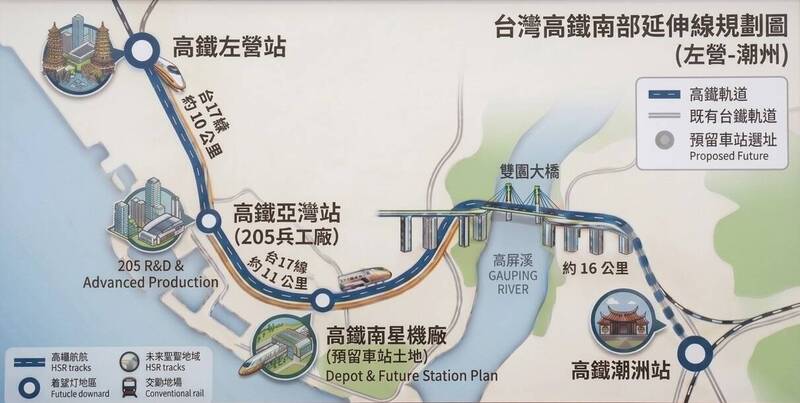
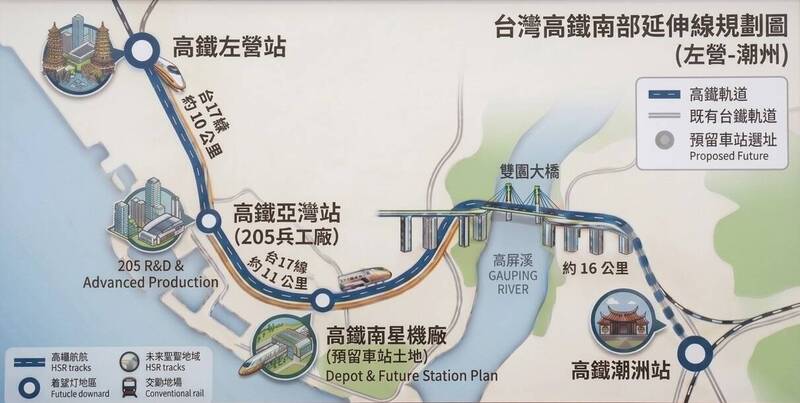
However, the online proposal argues that after leaving THSR Zuoying Station (高鐵左營站), the line could follow the Provincial Highway 17 (台17線) corridor, reducing land acquisition difficulties while improving commuting access for Cianjhen (前鎮), Siaogang (小港), and Linyuan (林園).
The proposer also called for a new THSR station in the Asia New Bay Area, possibly at the former 205 Arsenal site, saying it could bring high-speed rail into southern Kaohsiung’s core and support 5G AIoT industries and corporate headquarters.
The proposal suggests reserving land for a future station in the Nansing Project Area. If Kaohsiung’s proposed new airport is eventually built there, the area could become Taiwan’s only site combining high-speed rail and airport facilities, the proposer said.
The proposed route would then cross the Gaoping River (高屏溪) into Chaozhou, linking THSR service with Pingtung’s inland population center.
The proposer criticized the Cabinet-approved Kaohsiung plan, saying it largely overlaps with the Taiwan Railways (台鐵) corridor, could face major demolition and land acquisition disputes, and includes curves that would limit high-speed operation.
One reality check is that a Railway Bureau (鐵道局) report previously studied the Siaogang-Chaozhou option, and determined it would have major impacts on the urban environment and residents’ rights, lacks suitable station space, and would be extremely difficult to implement. The bureau concluded the plan was not feasible.
The proposed route, however, is relatively popular in southern Taiwan as it would involve much less construction in busy areas of Kaohsiung.