
Close Menu
Kaohsiung Times

    Hualien doctors use blood-based treatment to close severe eye holes

    British YouTuber complains about “ridiculous” prolonged Kaohsiung rain

    Kaohsiung’s August rainfall breaks 95-year record

    Facebook X (Twitter) Instagram Threads
    Kaohsiung Times
    Tuesday, September 1
    Facebook X (Twitter) Instagram
    • Latest
    • Kaohsiung
    • South
      • Pingtung
      • Tainan
      • Chiayi
    • Crime
    • Business
      • ESG
      • Technology
      • Energy
      • Real Estate
    • Politics
    • Lifestyle
      • Sports
      • Health
      • Entertainment
      • Travel
    • Long-form
      • Editorials
      • Formosa Files
      • Article Series
      • Books
    • Youth
    Kaohsiung Times
    • Latest
    • Kaohsiung
    • South
    • Crime
    • Business
    • Politics
    • Lifestyle
    • Long-form
    • Youth
    Home » Hualien doctors use blood-based treatment to close severe eye holes
    Health September 1, 20263 Mins Read

    Hualien doctors use blood-based treatment to close severe eye holes

    The approach helped two Kaohsiung patients after earlier operations had failed, though doctors say it is not suitable for everyone
    Share
    Facebook Twitter LinkedIn Email Copy Link Threads

    By KHT Staff

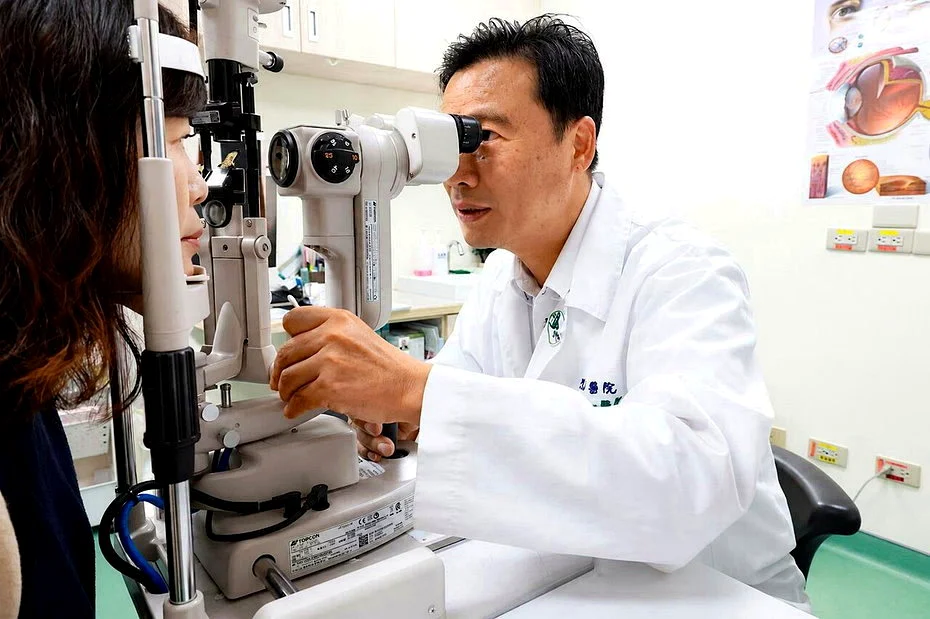
    HUALIEN — Doctors at Hualien Mennonite Christian Hospital (門諾醫院) say they used a thin layer of medical tissue and part of a patient’s own blood to help close difficult holes in the center of the eye.

    The treatment was used on a 38-year-old man from Kaohsiung whose vision was still affected after two earlier operations failed to close the hole.
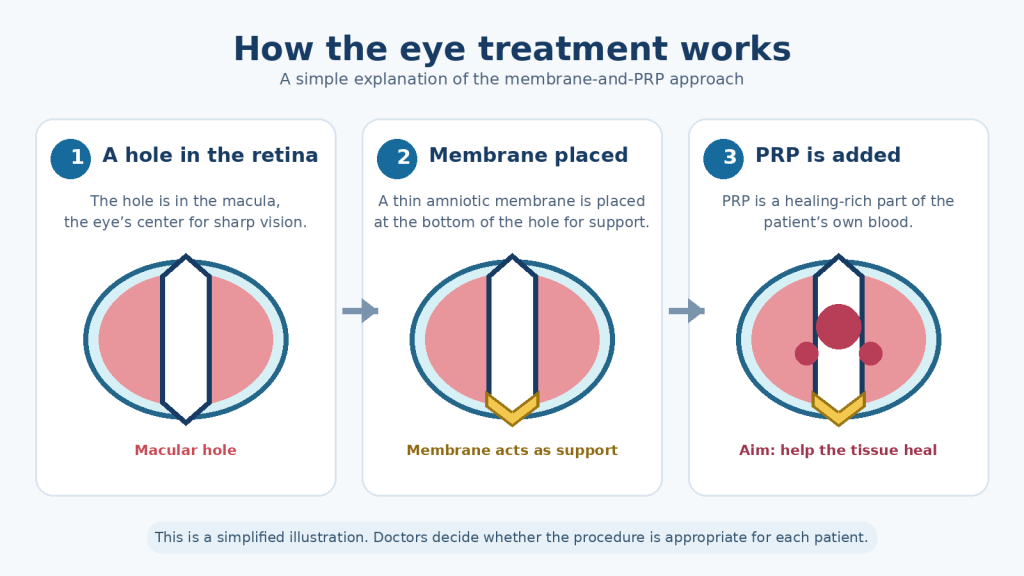
    The hole was in the middle of his retina, the light-sensitive layer at the back of the eye. More specifically, it was in the macula, the small central area that helps people see fine detail.

    Dr. Ho Ming-shan (何明山), an eye doctor at the hospital, said an ordinary macular hole is about 400 microns wide. A hole wider than 800 microns is considered large.

    The Kaohsiung patient’s hole was more than 2,100 microns wide — more than twice the size of a large hole. He also had difficulty seeing in the dark, a condition known as night blindness.

    The patient had already undergone two operations elsewhere. The hole remained open, and a membrane placed during an earlier operation had moved out of position.

    Ho said another standard operation carried a high chance of failure. After reviewing overseas medical reports, he decided to add platelet-rich plasma, or PRP, to the procedure.

    PRP is made by taking some of the patient’s own blood and spinning it in a machine to separate a part rich in platelets. Platelets are small parts of the blood that help the body heal damaged tissue.

    During the operation, doctors placed a medical amniotic membrane — a thin layer of human tissue used in some medical treatments — at the bottom of the hole. It supports the damaged retina. They then added PRP to create conditions that may help the tissue grow and close the gap.

    A follow-up scan showed that the 38-year-old patient’s large hole had closed, the hospital said.

    The hospital reported a similar result for another Kaohsiung patient with severe nearsightedness. That patient had a hole about 1,007 microns wide and had also undergone two unsuccessful operations before receiving the membrane-and-PRP treatment. A scan after the operation showed that the hole had fully closed.

    Ho said the method may offer another option for people with very large holes, holes that return after treatment, or holes that do not close after standard surgery. But he stressed that it is not right for every patient. Doctors must consider the size of the hole, the condition of the retina, severe nearsightedness, and the patient’s past operations.

    He advised people to see an eye doctor promptly if straight lines begin to look bent, objects look distorted, the center of vision stays blurry, or a dark spot appears in their sight.

    Source: United Daily News, reporting by Wang Sihui

    Featured heath Kaohsiung hospitals
    Share. Facebook Twitter Threads LinkedIn Email Copy Link

    Related Posts

    British YouTuber complains about “ridiculous” prolonged Kaohsiung rain

    September 1, 2026

    Council caucuses give Mayor Chen contrasting farewell gifts

    August 31, 2026

    Kaohsiung to add 1,200 bicycles to YouBike fleet

    August 31, 2026
    Add A Comment

    Comments are closed.

    British YouTuber complains about “ridiculous” prolonged Kaohsiung rain

    September 1, 2026

    Council caucuses give Mayor Chen contrasting farewell gifts

    August 31, 2026

    Kaohsiung to add 1,200 bicycles to YouBike fleet

    August 31, 2026

    Heavy rain triggers road collapse in Renwu

    August 31, 2026

    Luzhu Station’s 1966 building to make way for NT$170 million-plus replacement

    August 31, 2026

    Hualien doctors use blood-based treatment to close severe eye holes

    British YouTuber complains about “ridiculous” prolonged Kaohsiung rain

    Kaohsiung’s August rainfall breaks 95-year record

    Chen says Kaohsiung Purple Line review is moving ahead, urges faster budget vote

    Unimicron falls out of NT$1,000 club amid alleged “origin laundering”: How is “Made in Taiwan” determined?

    Council caucuses give Mayor Chen contrasting farewell gifts

    Facebook X (Twitter) Pinterest Vimeo WhatsApp TikTok Instagram

    News

    • Local
    • Business
    • Sports
    • Politics
    • Opinions
    • Lifestyle
    • Health

    News

    • Entertainment
    • Travel
    • Formosa FIles
    • Books
    • Technology
    • Youth
    • Latest

    Company

    • Information
    • Advertising
    • Contact Info
    • Privacy Policy & GDPR
    © 2026 Kaohsiung Times. Developed by Second Space.
    • Privacy Policy
    • Terms
    • Accessibility

    Type above and press Enter to search. Press Esc to cancel.