
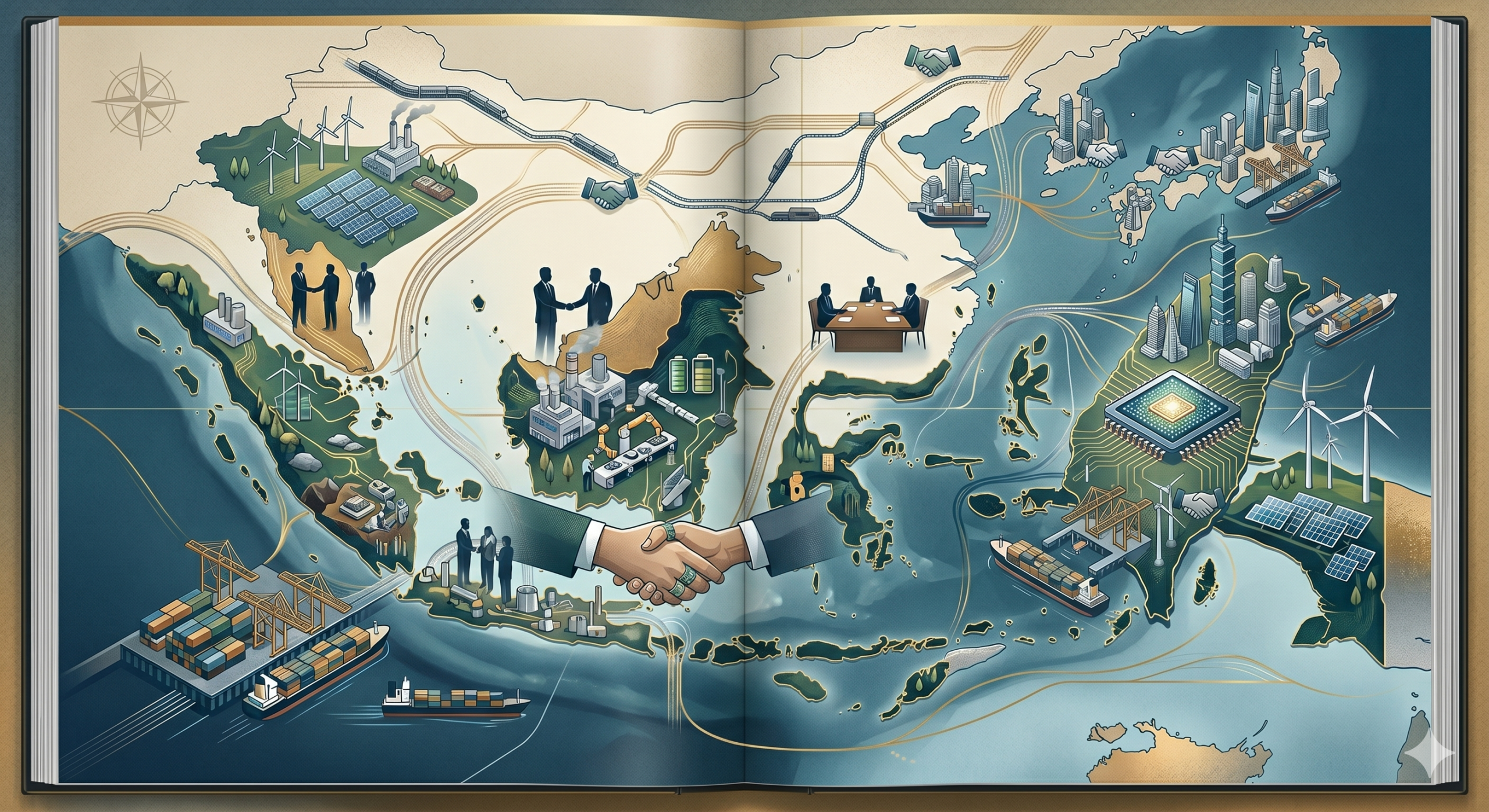
Opinion for Kaohsiung Times by Najamuddin Khairur Rijal. AI illustration image.
President Prabowo Subianto’s recent state visits to Japan and South Korea were widely framed in Indonesia as economic diplomacy success stories. The headline number alone is striking: investment commitments worth roughly Rp574 trillion (about US$33.8 billion) secured from Tokyo and Seoul across energy transition, critical minerals, digital infrastructure, manufacturing, and advanced technology sectors.
Yet the deeper significance of these visits lies not merely in capital inflows. In the increasingly polarized geopolitical environment of East Asia, this diplomacy carries strategic meaning for two actors observing closely from opposite sides of the Taiwan Strait: China and Taiwan. This economic engagement is, in fact, a recalibration of Indonesia’s geopolitical positioning in the Indo-Pacific.
The agreements reached during Prabowo’s Tokyo and Seoul visits extend beyond conventional trade cooperation. Japan committed investment packages exceeding US$22.6 billion focused on technology transfer, infrastructure, energy transition, and maritime security cooperation.
Meanwhile, South Korea and Indonesia elevated their partnership through agreements covering critical minerals, artificial intelligence, renewable energy, data centers, and defense collaboration, including continued development of the KF-21 fighter jet program.
Taken together, these deals indicate Indonesia’s entry into geo-economic alignment. Middle powers are no longer choosing sides militarily; instead, they diversify strategic dependencies through supply chains, technology ecosystems, and industrial partnerships.
For China and Taiwan, this matters profoundly because investment flows today function as geopolitical indicators. Capital increasingly follows strategic trust.
China Perspective
From Beijing’s perspective, Prabowo’s outreach sends a nuanced but unmistakable signal. China remains Indonesia’s largest trading partner and a central investor through Belt and Road Initiative projects. However, Indonesia’s engagement with US-aligned industrial economies reflects a pattern of soft balancing rather than confrontation.
Three implications emerge for China. First, Indonesia is hedging against overdependence. Global trade restructuring shows states diversifying economic partners amid rising geopolitical fragmentation.
By deepening cooperation with Japan and South Korea, both technological leaders embedded in US security networks, Indonesia expands strategic autonomy without openly opposing Beijing.
Second, the sectoral focus matters. Cooperation in critical minerals, batteries, and clean energy directly intersects with China’s dominance in global supply chains. Indonesia possesses vast nickel reserves essential for electric vehicle batteries; partnering with Japanese and Korean firms introduces alternative technological ecosystems competing with Chinese industrial integration.
Third, maritime and security dialogue embedded within economic agreements subtly reinforces Indonesia’s long-standing concern over Chinese activities near the Natuna Sea. Jakarta rejects China’s nine-dash line claims despite maintaining pragmatic economic ties. Thus, investment diplomacy doubles as geopolitical insurance.
Taiwan Opportunity
For Taiwan, this diplomacy carries a different meaning: opportunity within limitation. Indonesia officially adheres to the One-China Policy. Nevertheless, economic relations between the two have grown steadily through trade offices, investment cooperation, and educational exchange.
Prabowo’s strengthening of ties with Japan and South Korea indirectly benefits Taiwan in several ways.
First, Japan and South Korea form critical nodes in Taiwan-centered semiconductor and advanced technology supply chains. When Indonesia integrates more deeply with these economies, it effectively plugs into production networks where Taiwanese firms are indispensable players.
Second, Indonesia’s pursuit of technological industrialization aligns with Taiwan’s New Southbound Policy, which seeks deeper engagement with Southeast Asia to reduce economic vulnerability to mainland China. Indonesia’s openness to diversified high-tech investment creates structural space for Taiwanese participation, especially in electronics manufacturing and digital services.
Third, Jakarta’s hedging strategy reassures Taipei. An Indonesia that maintains balanced relations across major powers reduces the likelihood of Southeast Asia becoming exclusively dominated by China’s strategic orbit, an outcome Taiwan views as essential to preserving regional equilibrium.
Middle Power Moment
Prabowo’s diplomacy reflects a broader transformation underway across the Indo-Pacific, that the rise of middle power agency. Rather than choosing between Washington and Beijing, Indonesia increasingly practices multi-alignment. They leverage competition among great powers to maximize domestic economic transformation while preserving diplomatic autonomy.
Japan and South Korea see Indonesia as indispensable for supply-chain resilience, energy security, and market expansion. China recognizes Indonesia’s importance as ASEAN’s largest economy and maritime fulcrum. Taiwan perceives Indonesia as a gateway to Southeast Asian diversification.
In this triangular perception, Indonesia becomes less a peripheral actor and more a geopolitical swing state. Prabowo’s East Asia tour suggests an evolution toward what might be called strategic equidistance, active engagement with competing blocs while preventing dependency on any single one.
The investment outcome is therefore not merely economic success, but it is diplomatic architecture. Indonesia is constructing overlapping partnerships that anchor it simultaneously within Chinese markets, US-allied technology ecosystems, and broader Indo-Pacific supply chains.
China and Taiwan may interpret the visits differently, but both confront the same reality. Indonesia is positioning itself as a pivotal middle power capable of engaging all sides while belonging fully to none. Prabowo’s investment diplomacy demonstrates a sophisticated strategy: transforming geopolitical tension into national leverage.
About the Author:

Najamuddin Khairur Rijal is an associate professor in the International Relations
Department at the University of Muhammadiyah Malang, Indonesia