
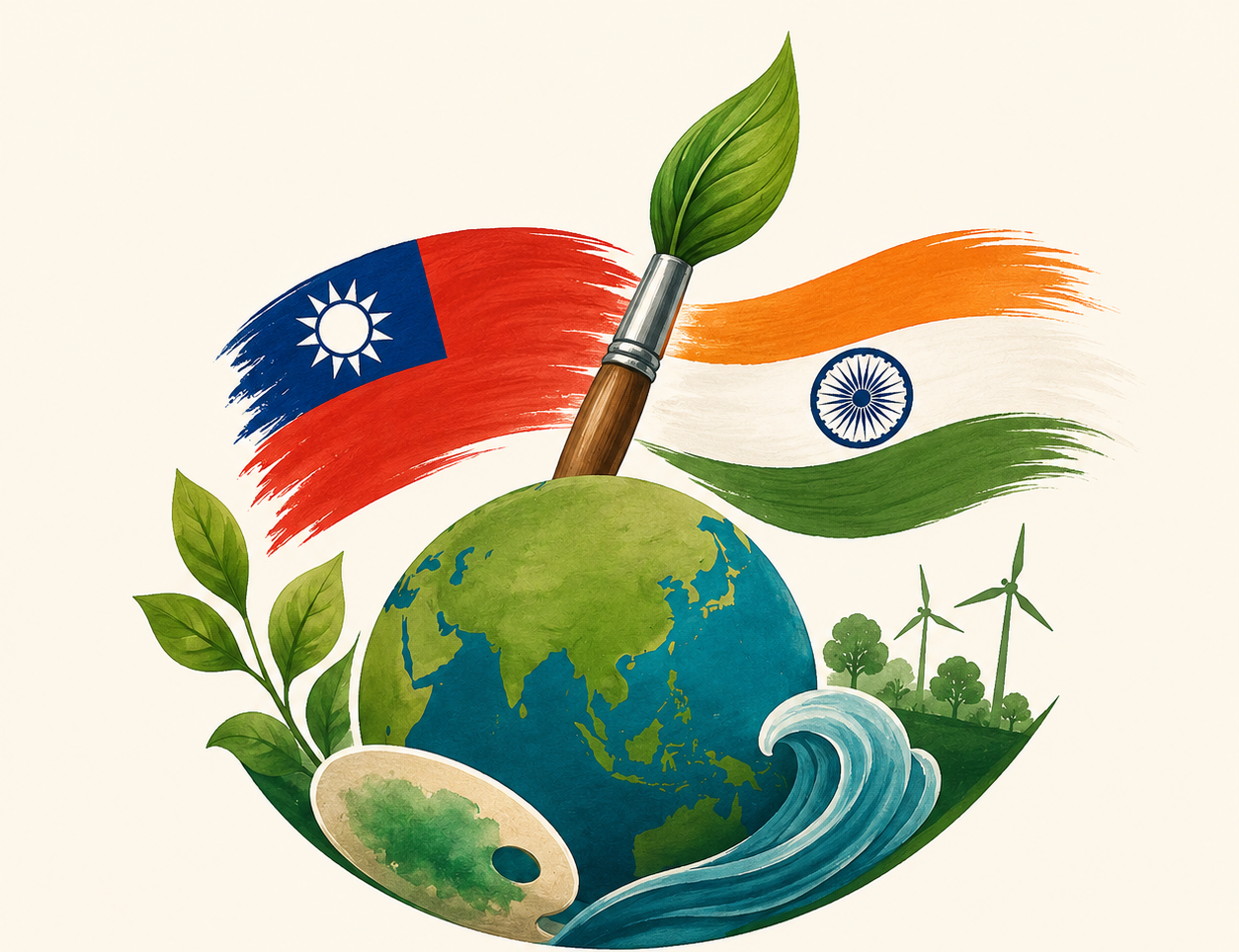
By Rachana Ahire, Assistant Professor, Department of Painting, K.K. Wagh College of Fine Arts in Nashik, India. AI illustration image.
In the contemporary world, the climate crisis is a challenge that cannot be solved through science or policy alone. It requires a fundamental shift in human behaviour and cultural perspectives. This is where the role of environmental art becomes critical. Both India and Taiwan possess excellent academic institutions and research centres, which, by working together, can provide global leadership in this field.
1. Interdisciplinary Research Environmental art is not limited to painting or sculpture; it is a convergence of biology, ecology, and material science.
Bio-material Research: Researchers in Taiwan are currently working on art materials made from ‘mycelium’ (mushroom roots) and seaweed. By collaborating with India’s agriculture-focused research institutes, such ‘bio-polymers’ can be developed for use in creating sculptures, serving as a complete alternative to plastic.
Ecological Restoration: Researchers can study how artworks can be designed to serve as bird nests or habitats for marine life. Using Taiwan’s ‘eco-art’ technology and India’s rich biodiversity data, research can be conducted on ‘restorative art.’
2. Joint Curricula and Student Exchange Programs Collaboration at the higher education level is the cornerstone for preparing the ‘eco-artists’ of the future.
Joint Degree Programs: Credit-based exchange programs can be initiated between Taiwanese universities and institutions and Indian universities and institutions.
Sustainable Design Curriculum: Experts from both countries can jointly develop a curriculum that teaches students how to create artworks without depleting local and natural resources. This can integrate technical subjects like ‘Life Cycle Assessment’ (LCA) with art.
3. Digital Technology and Data Visualization Taiwan’s strength in semiconductors and digital technology can be combined with India’s capabilities in data analysis and visualization.
Sensory Art Installations: A major area of research could be how environmental data (such as the Air Quality Index or water levels) can be displayed through art. For example, digital artworks that change their form as the environment becomes polluted. This research will make students more aware of the environment.
Virtual Labs: Through virtual reality, students from India and Taiwan can collaborate on a shared platform to design environmental art that transcends geographical boundaries.
4. Community Engagement and Regional Research A crucial part of research is understanding how art influences the behavior of local communities.
Case Studies: A comparative study can be conducted on the impact of ‘waste-to-art’ in rural Indian areas and ‘green roof art’ in urban areas of Taiwan. This research will provide valuable data for sociologists and artists.
Documenting Indigenous Knowledge: Both India and Taiwan have rich tribal traditions connected to nature. Incorporating these traditions into modern environmental art research is not only cultural preservation but also provides sustainable models for the future.
5. Incubation Centers and Startup Collaboration ‘Eco-art incubators’ can be established within educational institutions.
Green Startups: Students from art institutions can launch startups that supply sustainable materials or organize art exhibitions based on environmental issues. Taiwan’s ‘innovation culture’ and India’s ‘startup ecosystem’ can foster new entrepreneurs in this sector.
Educational and research collaboration in environmental art between India and Taiwan is not limited to awarding degrees. It is about preparing a generation that views art as a tool for ‘problem-solving.’ When two progressive nations combine their intellectual and technical strengths with sensitivity towards nature, they build a future where development and the environment complement each other. This partnership will undoubtedly set a new standard in the field of global ‘green education.’
(Author, Ms. Rachna Kailas Ahire, is an artist and serves as an Assistant Professor in the Department of Painting at K.K. Wagh College of Fine Arts, Nashik, Maharashtra, India) Official Website: https://fine-arts.kkwagh.edu.in/home/teaching