
By Dr. TUNG Chen-Yuan, Taiwan’s Representative to Singapore
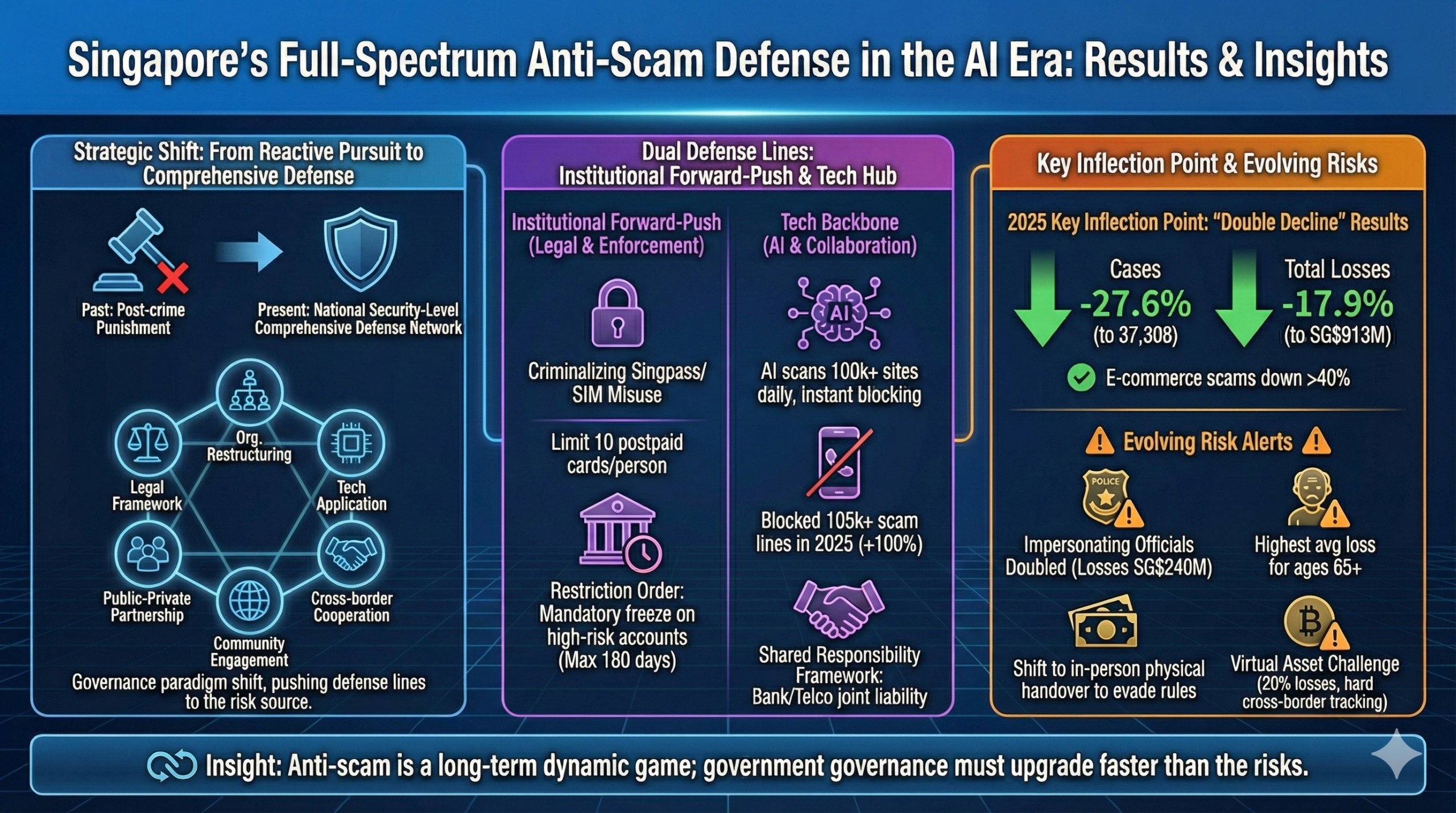
In recent years, Singapore has faced a sharp surge in digital fraud, elevating the issue to the level of national security alongside counterterrorism and anti–money laundering. Its governance approach has correspondingly shifted—from a traditional emphasis on post-offense criminal prosecution to the construction of a comprehensive defense network spanning six dimensions: legal reform, institutional restructuring, technological deployment, public–private partnership, community engagement, and cross-border cooperation. A cross-analysis of policy evolution and empirical data not only enables a clearer assessment of policy effectiveness and institutional boundaries but also reveals a rare turning point in crime trends in recent years.
Moving the Perimeter Forward: Pushing Safeguards Upstream
On the legal and institutional front, Singapore has strengthened early intervention powers through intensive legislative amendments, pushing anti-fraud enforcement toward the tools and facilitators of crime. Amendments to the Computer Misuse Act and the Miscellaneous Offences Act criminalize the reckless transfer of digital identities (Singpass) and the illegal transfer of registered SIM cards, lowering evidentiary thresholds for prosecuting “money mules” and accomplices.
Operationally, in 2025, the police identified over 4,600 Singpass-linked financial accounts that had been misused and took action against those involved, including account providers. Authorities also introduced a rule limiting each individual to registering a maximum of ten postpaid SIM cards. By the end of February 2026, an online self-check tool was launched to allow the public to verify their registered numbers, thereby constraining the misuse of communication tools at the source.
To curb illicit financial flows, amendments to the Corruption, Drug Trafficking and Other Serious Crimes Act introduced “reckless” and “negligent” money laundering offenses. The Protection from Scams Act established a Restriction Order regime, empowering police—under extreme high-risk circumstances—to freeze a potential victim’s bank account for up to 180 days, preventing individuals under deep psychological manipulation from continuing to transfer funds.
According to the latest statistics, from the law’s implementation through early February 2026, police issued 12 Restriction Orders to banks, buying critical intervention time for affected individuals. The proportion of victims who “voluntarily transferred funds to scammers” declined slightly from 82.4% in 2024 to 81.8% in 2025, suggesting that the long-term effectiveness of “protective intervention” warrants continued observation.
Technological Backbone: AI Detection and Real-Time Cross-Sector Collaboration
Technological enforcement and public–private collaboration form the core of Singapore’s defense system. The government launched the integrated ScamShield platform and a 24/7 anti-scam hotline, expanding blacklists through public reporting. The Scam Analytics and Tactical Intervention System (SATIS) uses AI to scan over 100,000 websites daily and connects with global technology platforms to block malicious links directly at the browser level—intercepting risk at the point of contact.
In 2025, police disrupted over 105,000 scam-linked mobile lines—an increase of more than 100% compared to 2024—reflecting a significant leap in technology-enabled enforcement capacity.
Institutionally, Singapore introduced a Shared Responsibility Framework featuring a cascading liability mechanism to reinforce the accountability of banks and telecommunications operators. Financial institutions have been encouraged to implement safeguards such as cooling-off periods for large transfers and temporary fund locks. The government has standardized “gov.sg” as the sole official SMS sender ID and requires social media platforms to conduct identity verification for high-risk sellers, thereby narrowing channels for phishing and disinformation. Fraud prevention has thus evolved from a purely criminal justice matter into a cross-industry system of shared risk governance.
Data Assessment: A Turning Point Emerges, Even as Risks Mutate
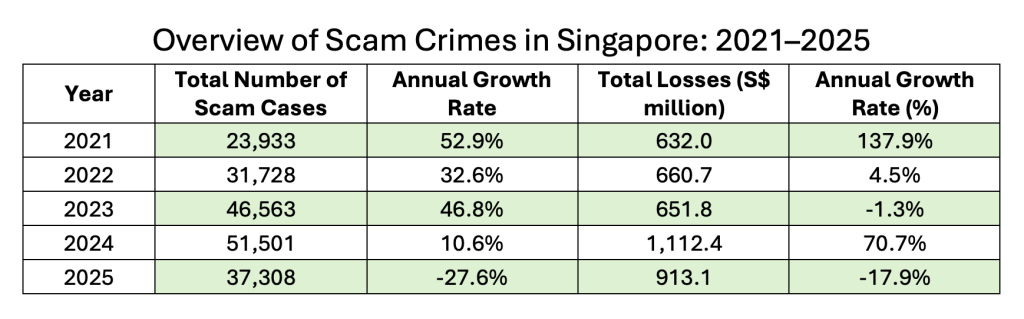
With sustained community outreach and cross-border enforcement cooperation, policy efforts have reached a turning point. In 2024, there were 51,501 reported scam cases, with annual growth moderating to 10.6%. In 2025, a rare “double decline” occurred: cases fell by 27.6% to 37,308, and total financial losses decreased by 17.9%—approximately S$200 million—to S$913.1 million. Nevertheless, losses remain elevated, exceeding the average of approximately S$260 million recorded in the three years prior to 2024.
Platform governance contributed to notable results: e-commerce scams, long the most prevalent category, declined by over 40% in 2025. That year, police and partners prevented an estimated S$348 million in potential losses and recovered or blocked approximately S$140.5 million, demonstrating that early warning systems and public–private collaboration have formed an effective buffer layer.
However, the risk structure is simultaneously evolving. In 2025, “government official impersonation scams” doubled to 3,363 cases, with losses rising to S$240 million. While victims were predominantly working-age adults, individuals aged 65 and above suffered the highest average losses per capita—over S$37,000. To circumvent tightening online financial controls, some scams have shifted to demanding in-person delivery of high-value physical assets such as gold and luxury watches. This underscores the scammers’ precise manipulation of authority bias and human vulnerability, which can still generate concentrated, high-impact harm.
The Challenge of Virtual Assets: Growing Complexity in Cross-Border Recovery
The anonymity and decentralization of cryptocurrencies have made them key conduits for laundering scam proceeds. In 2024, related losses surged to 24.3% of total fraud-related financial losses. In 2025, virtual asset scams remained the most formidable challenge, accounting for about one-fifth of total losses. The cryptocurrencies associated with the highest losses were Tether (approximately S$117.7 million), Ethereum (approximately S$26.1 million), and Bitcoin (approximately S$23.2 million). These developments not only create bottlenecks for traditional financial tracking mechanisms but also increase the complexity of cross-border asset recovery.
Overall, Singapore’s ability to rapidly deploy a dense anti-fraud architecture is closely linked to its 96% internet penetration rate, widespread digital identity adoption, retail banking concentration in three major local banks, and approximately 77% public trust in government. These structural conditions facilitate the implementation of measures such as transfer delays and account freezes.
Yet generative AI–enabled scams and virtual asset laundering continue to evolve, reminding us that combating fraud is not a one-off victory but an ongoing strategic contest. Institutions can build walls—and the recent “double decline” shows those walls are beginning to hold—but scam syndicates will always search for cracks. The decisive factor is whether governance capacity can upgrade faster than emerging risks, iterating institutional and collaborative mechanisms before threats proliferate.
The Taipei Representative Office in Singapore has released the report “An Analysis of the Fraud Crime Situation and Prevention Policies in Singapore.” The full text is available at the following link:
https://www.roc-taiwan.org/uploads/sites/85/2026/02/Scam-Web-Publication-_26022026_Final5.pdf
About the Author:

Dr. Tung Chen-Yuan is currently Taiwan’s Representative to Singapore. He was Minister of the Overseas Community Affairs Council of the Republic of China (Taiwan) from June 2020 till January 2023. He was Taiwan’s ambassador to Thailand from July 2017 until May 2020, senior advisor at the National Security Council from October 2016 until July 2017, and Spokesman of the Executive Yuan from May to September 2016. Before taking office, Dr. Tung was a distinguished professor at the Graduate Institute of Development Studies, National Chengchi University (Taiwan). He received his Ph.D. degree in international affairs from the School of Advanced International Studies (SAIS), Johns Hopkins University. From September 2006 to May 2008, he was vice chairman of the Mainland Affairs Council, Executive Yuan. His areas of expertise include international political economy, China’s economic development, and prediction markets.