
Opinion by Yu Jhou Chen (KAS- Grade 11)
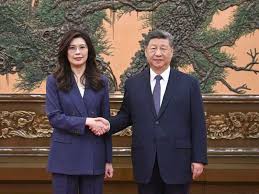
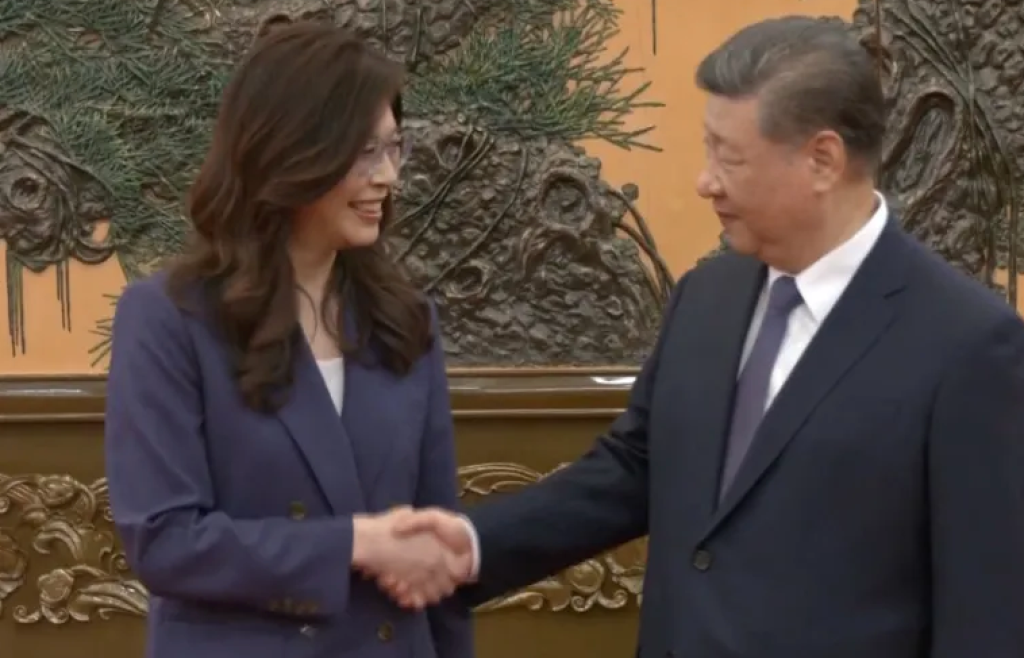
On April 12th, KMT chairwoman Cheng Li-wun returned to Taiwan from a six-day trip to mainland China. On this supposed “peace journey”, she visited Nanjing, Shanghai, and Beijing, culminating in a meeting with Chinese Communist Party General Secretary Xi Jinping at the Great Hall of the People on April 10th. It was the first face-to-face meeting between sitting KMT and CCP leaders in nearly a decade.
But for many Taiwanese watching the televised handshake, with Cheng bowing her head and Xi standing unmoved, the image told a completely different story. It showed not a meeting between equals but looked like a supplicant visiting the emperor.
To understand why Cheng’s trip matters, you have to understand the timing. The visit was announced on March 20th, just days after White House postponed a planned Trump and Xi summit to May 14th due to the Iran war. Scholars have argued that Beijing engineered the meeting to send a message to Washington.
John Lim, a project researcher at the University of Tokyo’s Institute for Advanced Studies on Asia, told CNA that Xi used the meeting to signal that there is broad Taiwanese support for Beijing’s position. Whether or not this is true, the KMT’s stance could weaken Washington’s ability to use Taiwan as a bargaining chip.
Perhaps the most damning aspect of the visit was what Cheng chose not to say. Bonnie Glaser, managing director of the Indo-Pacific Program at the German Marshall Fund, noted that Cheng failed to raise China’s ongoing military pressure on Taiwan. Glaser pointed out that this omission could be interpreted as implying that Beijing’s coercive actions are justified when framed as targeting “separatists”. For the chairwoman of Taiwan’s largest opposition party to sit across from the leader who has overseen a dramatic escalation of military provocations around Taiwan and say nothing about it is a profound failure of political leadership.
Meanwhile, China has reserved offshore airspace over the Yellow Sea and East China Sea from March 27th to May 6th, issuing NOTAMs that signal military exercises. The KMT has simultaneously blocked President Lai Ching-te’s proposed NT$ 1.25 trillion special defense budget. Cheng’s party is obstructing Taiwan’s defense while its leader shakes hands with the very person those defenses are meant to deter. What a leader she is.
Cheng also made a subtle rhetorical shift during her trip on the 1992 Consensus. The Consensus has traditionally been defined as “One China, different interpretations”. But as the Diplomat reports, Cheng instead phrased it as “One China, oppose Taiwanese independence”. Xi echoed this exact formulation in their meeting. The “different interpretations”, the only part that was favorable to Taiwan, was dropped. What a leader she is.
The most fundamental problem with Cheng’s trip is that it does not reflect what the majority of Taiwanese actually want. According to a 2025 survey by the National Chengchi University Election Study Center, 62% of respondents identified as “Taiwanese”, up from 17.6% in 1992. The overwhelming majority remains maintaining the status quo and not pursuing unification with China.
Yet Cheng, during her rise to the KMT chair, still said how she hoped to one day see “Taiwanese proud to be Chinese”. As one Taiwanese voter told the Christian Science Monitor from a bus stop in Hualien, “Taiwan is a democratic, autonomous country. Going there is tantamount to bowing down and submitting”. A retired businessman in Taipei Ningxia Night market was blunter: “It’s like she’s Xi Jinping’s daughter”.
Cheng’s visit was not a peace mission but a performance. She did not speak to Taiwan’s 23 million people. With the 2026 local elections approaching, Cheng’s strategy is already showing its cracks. KMT support has dropped 20% while the DPP holds steady at 25%. Even KMT mayoral contenders like Ko Chih-en have reportedly distanced themselves from Cheng’s cross-strait rhetoric.
As President Lai wrote on Facebook after the Cheng-Xi meeting: “History tells us that compromising with authoritarian regimes only sacrifices sovereignty and democracy; it will not bring freedom, nor will it bring peace.”
Taiwan’s democracy was not built so its opposition leaders could trade it away in a thirteen-second handshake. What a leader she is.