
By RK Shih / Staff
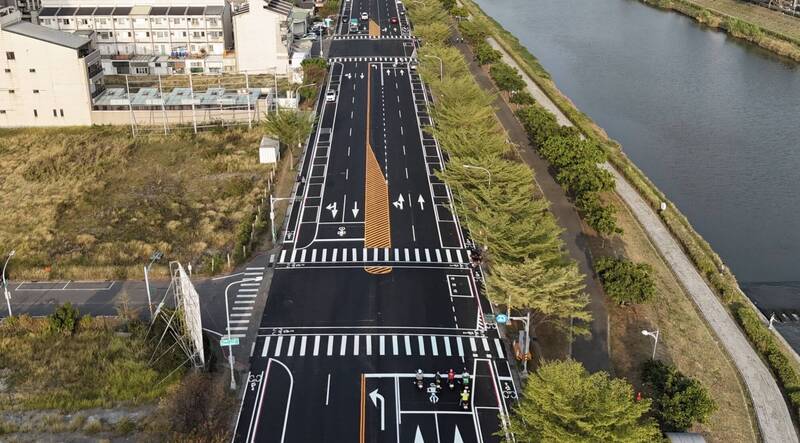
KAOHSIUNG — Kaohsiung is narrowing vehicle lanes and adding a protected bicycle lane separated by a parking buffer in a redesign of a section of Yuanzhong Road (援中路) in Nanzih District (楠梓區).
The project was carried out during a scheduled road resurfacing effort jointly coordinated by the Kaohsiung Transportation Bureau (高雄市交通局) and the Public Works Bureau (工務局). Officials said the redesign provided an opportunity to reconsider how the roadway’s space is used.
Previously, Yuanzhong Road featured two fast lanes and one slower lane in each direction. Some of the lanes were unusually wide, which transportation planners say tends to encourage speeding.
Under the new design, the city has reduced lane widths and redistributed the available space. A parking lane along the curb now acts as a physical buffer between moving traffic and a newly designated bicycle lane, creating what planners call a “parking-protected bike lane.” The layout is intended to reduce direct interaction between bicycles and motor vehicles.
Kaohsiung has already used similar designs on Bo-ai Road (博愛路) in Sanmin District (三民區) and Kaisyuan Road (凱旋路), between Heti Street (河堤街) and Fongding Road (鳳頂路), in Fongshan District (鳳山區). Officials say the Yuanzhong Road redesign is part of a broader effort to gradually build a safer and more continuous cycling network across the city.
Not all cyclists, however, are fans of this type of bike path. Some say they want a dedicated lane with some type of barrier — that’s not a parked car. The city, however, says the protected bike lane design improves safety by reducing the number of points where bicycles and vehicles interact.
Transportation officials said the redesign also includes added left-turn pockets at certain intersections to improve traffic flow and reduce turning conflicts.
City officials argue that narrower lanes often encourage drivers to slow down and pay closer attention. Studies in traffic engineering have shown that lane reductions can help reduce speeding and lower the frequency of serious crashes when implemented correctly.