
By Eryk Michael Smith / Staff
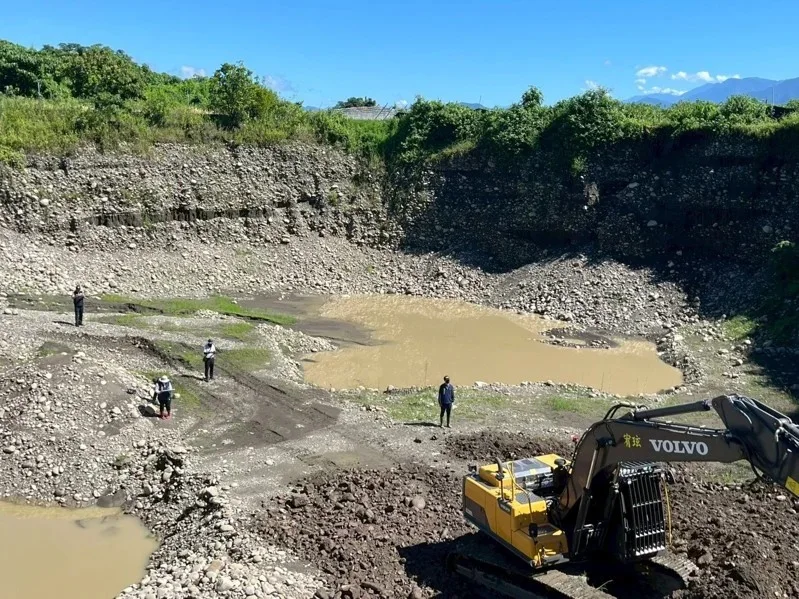
KAOHSIUNG — What began as a bizarre landscape anomaly in Meinong District (美濃區) has now exploded into one of southern Taiwan’s largest coordinated environmental crime prosecutions in recent memory.
The Ciaotou District Prosecutors’ Office (橋頭地檢署) announced this week that 106 individuals have been indicted for illegal excavation and waste-dumping operations across Meinong and neighboring Dashu District (大樹區). Authorities say the total area stripped of soil is equivalent to two Chengcing Lake Baseball Stadiums (澄清湖棒球場) — a scale prosecutors described as unprecedented.
Investigators conducted 14 separate search operations, questioned more than 200 individuals, and seized almost NT$32 million in cash, along with 43 land parcels and 38 heavy vehicles. Prosecutors say the crimes were not the work of a single group, but multiple organized rings operating with similar playbooks.
The Fake Farming Scheme
One of the rings — led by men surnamed Luo (羅) and Huang (黃) — allegedly recruited intermediaries to pose as legitimate agricultural tenants. They targeted farmland in Meinong’s Jiyang Section (吉洋段), classified for agricultural use, and told landowners they planned to grow water spinach and other crops.
Instead, once lease contracts were secured, excavators were brought in.
Fertile farmland was dug to depths of up to 12 meters. High-quality soil was transported and sold to gravel yards. Prosecutors estimate that at least 30,000 metric tons were removed, generating illegal profits of roughly NT$7 million in this ring alone.
After authorities issued orders halting soil removal, the operation allegedly escalated rather than stopped. Instead of restoring the land with clean fill, suspects are accused of dumping construction waste — including bricks, concrete debris, plastic refuse, and even tires — into the pits, covering them with thin soil to conceal the contamination.
Organized Crime Charges
The Ciaotou prosecutors have charged defendants under the Organized Crime Prevention Act, the Waste Disposal Act, and aggravated theft statutes. Prosecutors argue the defendants operated with a clear division of labor, a sustained profit motive, and long-term planning.
Among those indicted in the broader investigation are a former Kaohsiung prosecutor and a former city council aide. In one case, investigators allege a suspect applied for gravel transport permits to shield trucks hauling illegally extracted soil and waste.
Prosecutors say restoration costs for some parcels alone could range between NT$5 million and NT$12 million.
A Systemic Problem
The “Meinong Grand Canyon” nickname, once used almost casually, now reflects something more serious: a pattern of exploitation targeting agricultural land under the guise of farming.
Officials stress that this was not opportunistic dumping but coordinated extraction and resale of high-grade soil, followed by deliberate contamination to cut cleanup costs and collect additional disposal fees.
For Kaohsiung, a city that has spent years rebranding itself around environmental renewal and green transition, the scale of the indictments is sobering. It’s unclear how the scandal may affect the 2026 mayoral race, but it’s almost certainly going to become part of the debate. Also unknown: is this major bust a milestone marking the end of such operations, or merely the exposure of possibly much deeper networks?
The case now moves to court, where prosecutors are seeking heavy sentencing and confiscation of criminal proceeds.