
Essay Submission to Kaohsiung Times by Moham (Zheng) Wang (Singapore)
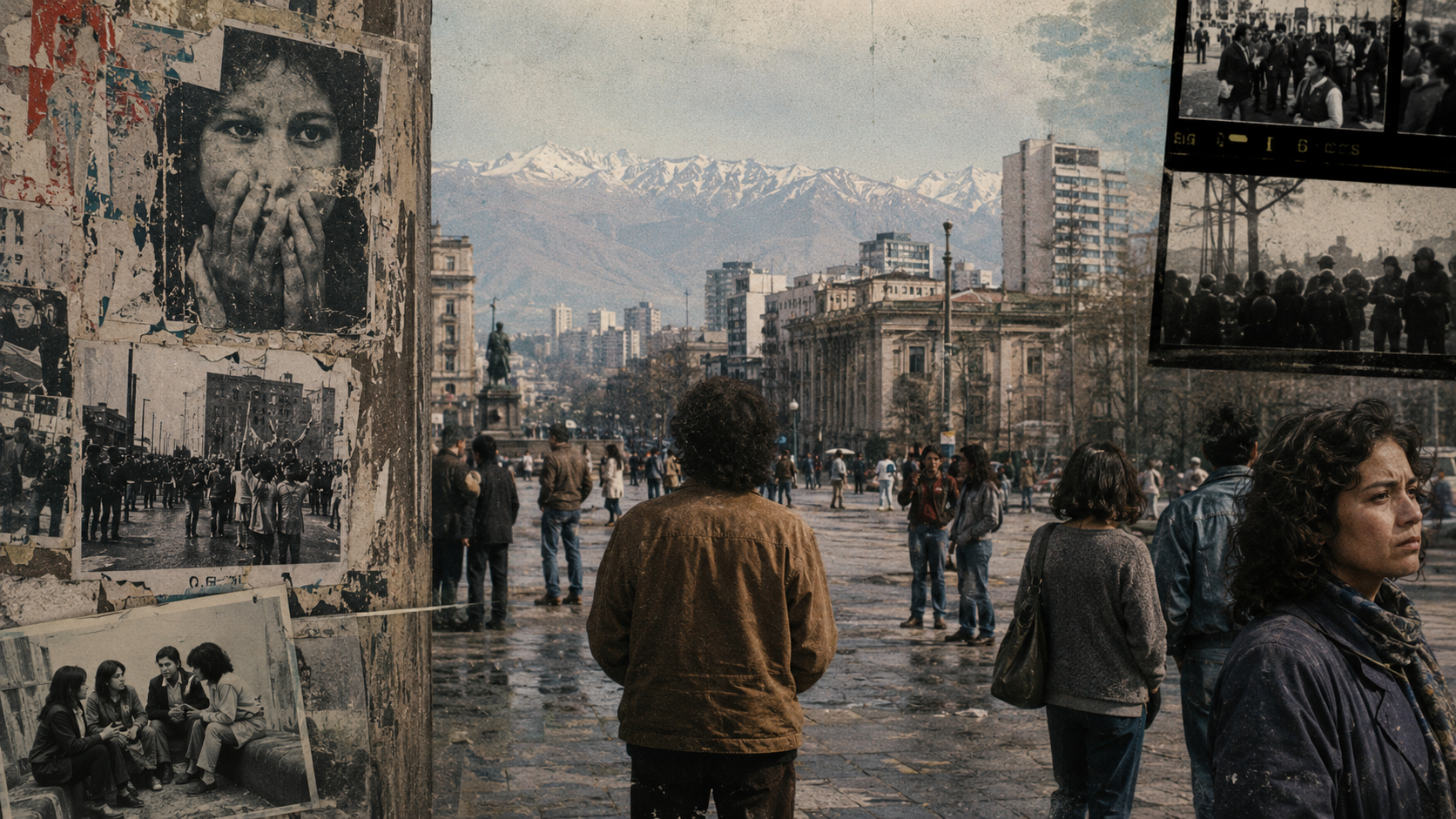
AI illustration image
For many Asian readers, Chile often feels like a familiar yet distant name. People know it as the land of Neruda, of long coastlines, of the 1973 military coup, and of Augusto Pinochet, who established one of the twentieth century’s most notorious military dictatorships. But what happens after the dictatorship ends? When the grand events of history have exited the stage, how do ordinary people actually begin their lives anew? And how does democracy grow its own flesh and blood once more?
Hora Cero de la Democracia en Chile: Fotografías de inicios de los 90 (Chile’s Hour Zero of Democracy: Photographs from the Early 90s, When Everything Began), co-created by photographer Kena Lorenzini and researcher Cynthia Shuffer, is precisely a work that addresses these questions. Published in 2018, this photography book contains a large collection of images taken between 1990 and 1994, documenting the social landscape of Chile during the first few years of its transition from military regime to democratic government. The “Hora Cero” (Hour Zero) in the title suggests both a countdown to the start of a new era and an unfinished point of departure. Flipping through the book, I kept realizing that it is not a commemorative album about the triumph of democracy, but rather something more like a field notebook on democracy’s fragility.
As an Asian writer living in Latin America, reading this book gave me a strange sense of dislocation. The people in the photographs speak Spanish, the streets are in Santiago, and the slogans on the walls belong to Chile’s specific historical context—yet the emotions conveyed by those images feel strangely familiar.
Many people are accustomed to understanding a democratic transition as a kind of historic moment. In 1988, the Chilean plebiscite rejected Pinochet’s bid for another term; in 1990, Patricio Aylwin was inaugurated as president, and thus democracy seemed to have returned. Yet Lorenzini’s lens reveals another truth: the shift in political institutions does not mean the disappearance of the old order. In many photographs, the military still occupies public spaces; on many occasions, Pinochet’s presence still lingers. Even though he was no longer president, he remained Commander-in-Chief of the Army, the military retained enormous political influence, and the constitution enacted during the military regime remained in effect.
Thus, we see a disturbing picture: democracy has arrived, but dictatorship has not yet left.
This is precisely the true meaning of “Hour Zero.” It is not the birth of a new world, but the overlap of two worlds. If photography possesses a particular power, it lies in its ability to preserve those details of historical transition that are difficult for words to fully capture. In Hora Cero, we see no grand historical narratives, no textbook-style victory declarations. Instead, we see the faces of ordinary people. Some are protesting, some are waiting, some are staring into the distance on the streets. These people may know that history has changed, but they do not yet know what the future will become.
Susan Sontag wrote in Regarding the Pain of Others:
“To remember is, more and more, not to recall a story but to be able to call up a picture.”
In her view, collective memory in modern society depends increasingly on images rather than narratives. People may not remember the full historical process, but they will remember a face in a photograph, a slogan on a street corner, or a crowd at a protest. The value of Hora Cero lies precisely here. It does not attempt to construct a grand theory about Chile’s democratic transition, but rather preserves those moments that historical narratives might overlook. As political debates shift and official versions are continuously revised, photographs retain a certain testimonial function that cannot be entirely erased—bearing witness to that important uncertainty.
This uncertainty is also the central challenge of transitional justice.
As Ruti Teitel argues in Transitional Justice, societies in transition must simultaneously pursue justice and political stability, and these goals often conflict. Chile is precisely such a case. After democratization, the new government had to reckon with the power still held by the military and avoid falling back into political confrontation. As a result, the comprehensive reckoning that many victims had hoped for did not come immediately. For some, this was a compromise; for others, it was a necessary price to prevent democratic collapse.
This is also why Hora Cero is most worth reading for Asian societies. Because it offers no heroic answers, but instead shows us the real-world conditions of democratic transition.
In Asia, many discussions about transitional justice tend to fall into binary oppositions. Some believe that history should be thoroughly settled, while others argue for moving forward and not dwelling on the past. Yet Chile’s experience shows that the actual historical process is far more complex than these slogans suggest. Democratic transition is neither forgetting nor revenge, but a social negotiation that lasts for decades.
Taiwan’s case is especially illustrative. Nearly four decades have passed since the end of martial law, yet the White Terror, authoritarian symbols, and historical memory remain important topics in public debate. In a sense, Taiwan is still undergoing its own “Hora Cero.” The democratic system is already stable, but the disputes over how to understand the authoritarian era and how to deal with its historical legacy have never truly ended.
It is worth noting that although this book focuses on political transition, its real concern is ultimately people. Lorenzini does not point her lens exclusively at political figures, but instead photographs ordinary citizens more often. In Hora Cero, what is being looked at is not power itself, but how power affects people’s lives.
In this way, the book transcends the category of ordinary political photography collections. It is both a historical document and a visual ethnography of public life. It makes readers realize that democracy exists not only in constitutions and ballots, but also in streets, markets, parks, and the encounters between people. True democratization is not just institutional change, but the return of public space to its citizens.
For today’s Chinese-speaking world, Hora Cero carries an additional layer of special significance. For a long time, Asian societies have been accustomed to seeking democratic theories and political experiences from Europe and America, while paying less attention to Latin America. Yet from a historical perspective, Latin America actually offers a wealth of cases worth referencing: military dictatorships, truth commissions, human rights trials, and the long process of democratic consolidation. Many of the problems that Asian societies face today have already appeared in Latin America before.
Thus, Hora Cero is not just a book about Chile and Latin America. It is also a mirror, allowing Asian readers to re-examine their own historical positions. Reading to the end, my deepest feeling was not optimism, but a kind of humility. This book makes one understand that democracy has never been the endpoint of history, nor a state that can be permanently acquired. It is more like a public practice that requires ongoing maintenance, a social project of continuous negotiation between memory and forgetting.
Perhaps what Hora Cero truly wants to tell us is this: in history, there is no real Hour Zero. Every new beginning carries shadows of the old era; every democratization leaves behind unresolved questions. What matters is not whether we reach the destination, but whether, along this long road, we are still willing to preserve memory, confront the past, and continue to believe in the possibility of public life.
This is true for Chile, and it is true for Asia as well.
Author Bio
Wang Zheng, born in Wuhan, of Yao ethnicity. Currently resides in Singapore. Member of the Independent Chinese PEN Center. Recipient of the 2020 “Wang Guozhen Poetry Prize,” 2023 Taiwan “4th Luo Ye Literature Prize” for fiction, Singapore “Xinhua Youth Literature Prize” for poetry, Singapore 2024 “Lianhe Zaobao Gold Prize” and first place in the fiction category, and second place globally in Hong Kong’s 4th “Bauhinia Poetry Prize.” Chinese poetry and fiction have appeared in Tsingtao Literature, Youth, Young Writers, Taiwan’s Taike Poetry Journal, Vineyard, China Daily supplement, Liberty Times supplement, as well as Hong Kong’s Voice & Verse Poetry Journal, P-articles, and Hong Kong Literature. English poetry has appeared in Queer Southeast Asia, Malaysia Indie Fiction, Woman, The Asian CHA, and Voice & Verse magazine. Poetry and illustrations selected for the 2023 Chengdu Biennale parallel exhibition “Perceptual Geography.” He holds a BA in Studio Art and Art History from Rice University, an MA in Aesthetics and Politics from the California Institute of the Arts, and was a PhD candidate on full scholarship in Art at Nanyang Technological University, Singapore.