
By Dr. TUNG Chen-Yuan, Taiwan’s Representative to Singapore
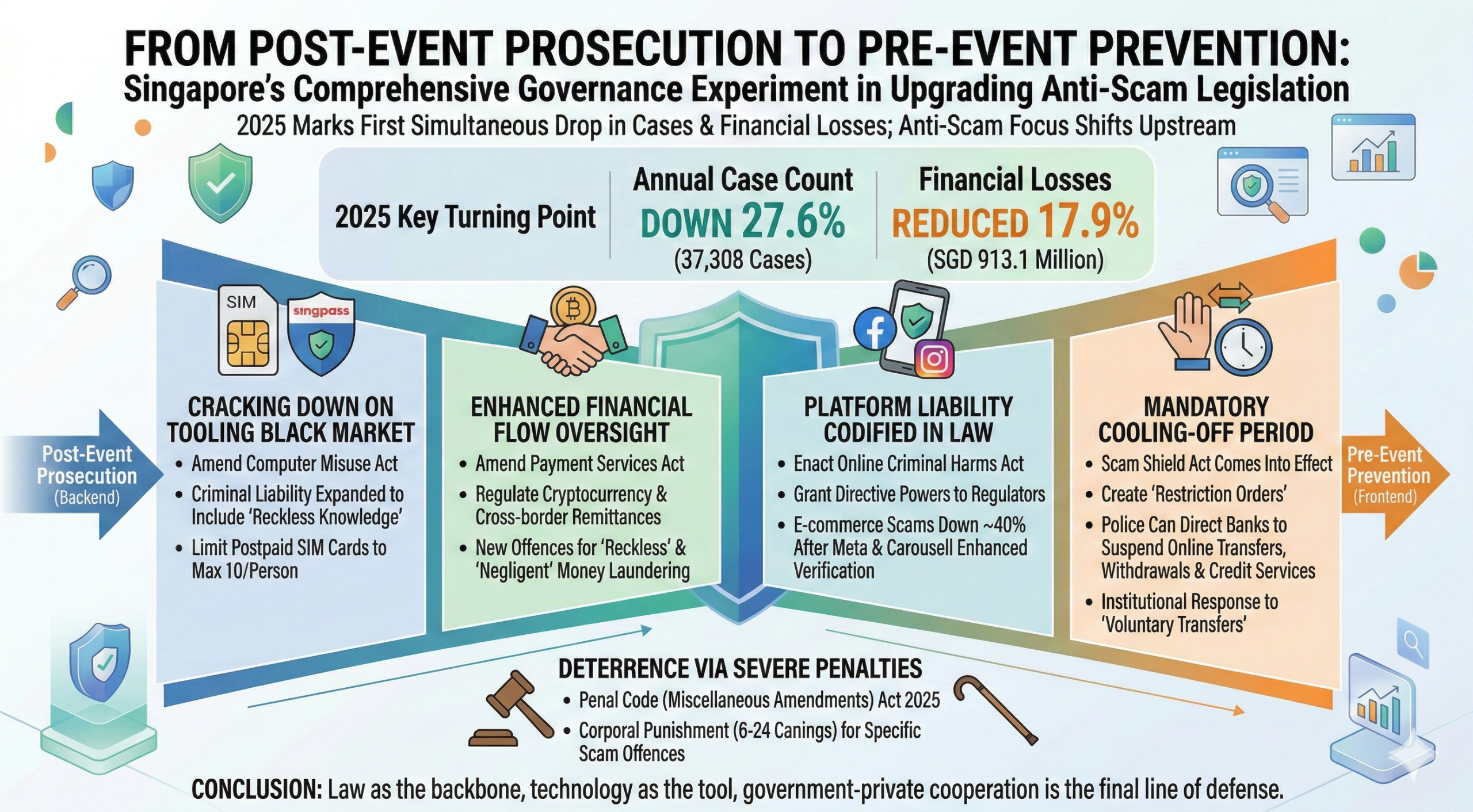
In recent years, Singapore has faced unprecedented pressure from scam-related crimes. In 2024, the number of scam cases exceeded 51,000, with financial losses surpassing S$1.1 billion—both record highs. However, following a series of institutional reforms and strengthened public-private collaboration, 2025 marked a turning point: total cases fell by 27.6% to 37,308, while financial losses declined by 17.9% to S$913.1 million. It was the first time both case numbers and losses registered a simultaneous drop.
Yet structural challenges remain. As many as 81.8% of cases involved so-called “voluntary transfers” carried out under intense psychological manipulation. When victims are persuaded—sometimes to the point of near brainwashing—to transfer funds of their own accord, a traditional enforcement model centered on investigation and prosecution after the fact is unlikely to be sufficient. The core of modern scams has shifted from exploiting technical loopholes to exploiting human psychology.
Confronted with increasingly organized, technologically sophisticated, and psychologically manipulative scam syndicates, Singapore has undertaken systematic legal reforms since 2020. The focus has gradually shifted from post-facto prosecution to pre-emptive prevention and upstream disruption. From restricting access to tools, tightening financial supervision, and imposing platform accountability to strengthening criminal penalties, the government has constructed a multi-layered defensive framework.
Compressing the Tools Black Market: Lowering the Threshold for Establishing Culpability
Scam operations rely heavily on anonymous communications and mule accounts. In the past, prosecutors often struggled to prove that individuals who provided bank accounts or communication tools had actual knowledge of fraudulent activity, leaving intermediaries in a legal grey zone. To close this gap, Singapore amended the Computer Misuse Act and the Miscellaneous Offences Act, extending criminal liability to situations where a person “ought reasonably to have known” or failed to exercise due diligence.
Under the revised framework, individuals who recklessly hand over digital identity credentials such as Singpass, or who illegally possess or transfer SIM cards not properly registered, may face criminal charges even if they did not directly participate in the core scam. The law now demands not only the absence of intentional complicity, but the presence of reasonable vigilance. By raising legal risks, the cost of acquiring operational tools for scam syndicates has increased significantly.
In 2025, police disrupted more than 105,000 scam-linked mobile lines—more than double the previous year’s figure. From February 2026 onward, a new rule limits each individual to registering a maximum of 10 postpaid SIM cards, alongside an online self-check tool to reduce abuse of communication resources at the source.
Tightening Financial Oversight: Closing Laundering and Mule Account Loopholes
On the financial front, Singapore has strengthened regulatory oversight. Amendments to the Payment Services Act brought cryptocurrency service providers and cross-border remittance operators fully within anti-money laundering (AML) and counter-terrorism financing (CFT) frameworks, requiring enhanced customer due diligence and suspicious transaction monitoring. In June 2025, the Monetary Authority of Singapore imposed fines totaling S$960,000 on five major payment institutions for compliance failures, signaling firmer regulatory enforcement.
Meanwhile, amendments to the Corruption, Drug Trafficking and Other Serious Crimes (Confiscation of Benefits) Act introduced new offences for “reckless” and “negligent” money laundering, as well as assisting others in retaining criminal proceeds. Individuals who provide bank accounts or facilitate transfers without conducting reasonable checks may no longer rely on claims of ignorance as a defense. The message is clear: in high-risk environments, passive negligence can itself attract criminal liability.
Codifying Platform Responsibility: Requiring Tech Companies to Share the Burden
Most scam communications are disseminated through cross-border social media platforms and messaging applications. Singapore’s Online Criminal Harms Act empowers authorities to issue legally binding directions to online service providers, requiring them to block specific communications, restrict content, or remove scam-related applications. Non-compliance can result in substantial fines.
This marks a shift away from reliance on voluntary self-regulation toward legally enforceable obligations. After platforms such as Meta and Carousell strengthened seller identity verification in line with regulatory requirements, overall e-commerce scam cases fell by about 40% in 2025. Authorities have also required Apple and Google to assist in blocking scam messages impersonating government agencies.
As platforms become central nodes of information flow, the scope for claiming “technological neutrality” narrows. Influence derived from algorithms and traffic inevitably carries governance responsibilities.
Mandatory Cooling-Off Orders: A Systemic Response to “Voluntary Transfers”
Perhaps the most innovative reform is the Protection from Scams Act, which came into force in July 2025. The Act introduces “restriction orders,” allowing police—when reasonably satisfied that an individual is at risk of being scammed but refuses intervention—to direct banks to suspend the person’s online transfers, ATM withdrawals, and certain credit services.
As of early February 2026, 12 restriction orders had been issued, successfully buying time to prevent further losses. In urgent situations, the state temporarily intervenes in an individual’s ability to dispose of assets, creating a mandatory “cooling-off period.” In contexts of intense psychological manipulation, rational judgment may falter; the objective is to use time as a safeguard for clarity.
How to maintain a proportional balance between protecting property autonomy and preventing significant financial harm will remain an important issue for continued evaluation.
Enhanced Deterrence: Raising the Cost of Crime
On the punitive side, amendments to the Criminal Law (Miscellaneous Amendments) Act passed in late 2025 extended caning to certain scam-related offences. Masterminds and core members of scam syndicates may face between six and 24 strokes of the cane, while accomplices may also be sentenced at the court’s discretion.
The intention is to substantially raise the cost of participation and strengthen deterrence. Whether severe penalties within a single jurisdiction can alter the risk-reward calculations of cross-border, decentralized criminal networks, however, remains to be seen.
Conclusion: An Integrated and Forward-Shifted Governance Model
Overall, Singapore’s anti-scam reforms demonstrate a clear trajectory: from reactive prosecution to proactive prevention; from individual accountability to shared responsibility across platforms and financial institutions; and, where necessary, to calibrated state intervention. By lowering evidentiary thresholds, tightening financial supervision, codifying platform obligations, and introducing restriction orders, the government has equipped enforcement agencies with more proactive tools—contributing to the first simultaneous decline in cases and losses in 2025.
Nonetheless, scam crimes are inherently transnational, decentralized, and rapidly evolving. Although overall numbers have fallen, scams involving impersonation of government officials have increased, and some syndicates have shifted to in-person transfers of gold bars or luxury watches to evade digital monitoring. As technology evolves and tactics adapt, the law must keep pace.
Stronger penalties and institutional innovation can raise costs and slow damage. But the long-term solution lies in deeper cross-border cooperation, continued advancement in financial technology, and enhanced digital literacy among the public. In this contest between offense and defense, the law provides the framework, technology supplies the tools, and sustained cooperation between government and society remains the ultimate safeguard.
About the Author:

Dr. Tung Chen-Yuan is currently Taiwan’s Representative to Singapore. He was Minister of the Overseas Community Affairs Council of the Republic of China (Taiwan) from June 2020 till January 2023. He was Taiwan’s ambassador to Thailand from July 2017 until May 2020, senior advisor at the National Security Council from October 2016 until July 2017, and Spokesman of the Executive Yuan from May to September 2016. Before taking office, Dr. Tung was a distinguished professor at the Graduate Institute of Development Studies, National Chengchi University (Taiwan). He received his Ph.D. degree in international affairs from the School of Advanced International Studies (SAIS), Johns Hopkins University. From September 2006 to May 2008, he was vice chairman of the Mainland Affairs Council, Executive Yuan. His areas of expertise include international political economy, China’s economic development, and prediction markets.