
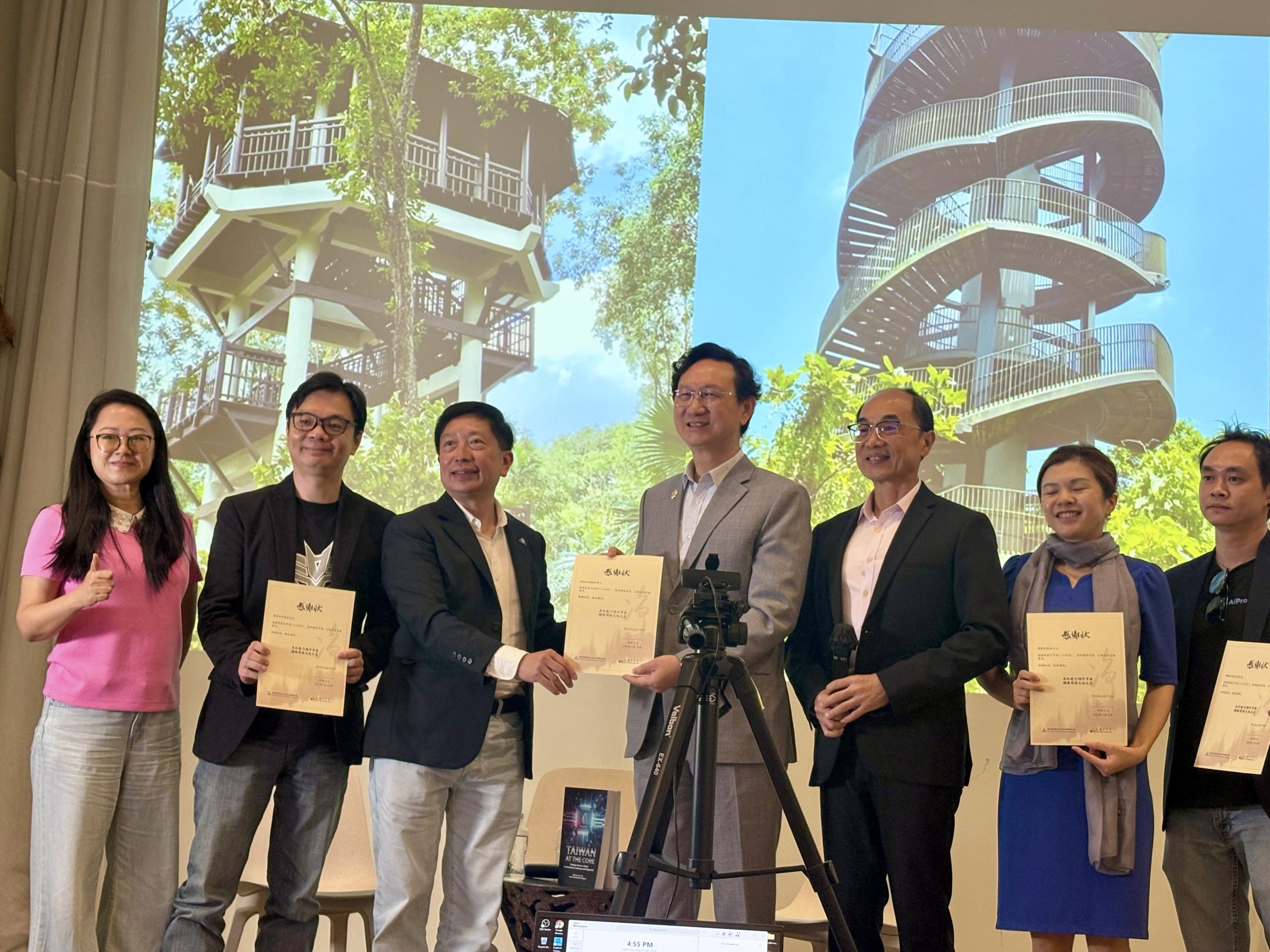
Dr. TUNG Chen-Yuan, Taiwan’s Representative to Singapore
March 28, 2026
At a critical juncture marked by intensifying global technological competition and supply chain reconfiguration, semiconductors and artificial intelligence have emerged as central pillars of international strategy. Over the past three years, we have anchored our efforts in tech diplomacy, continuously deepening collaboration between Taiwan and Singapore in high-tech sectors, while enabling the international community to better recognize Taiwan’s pivotal role in the global semiconductor and AI industries.
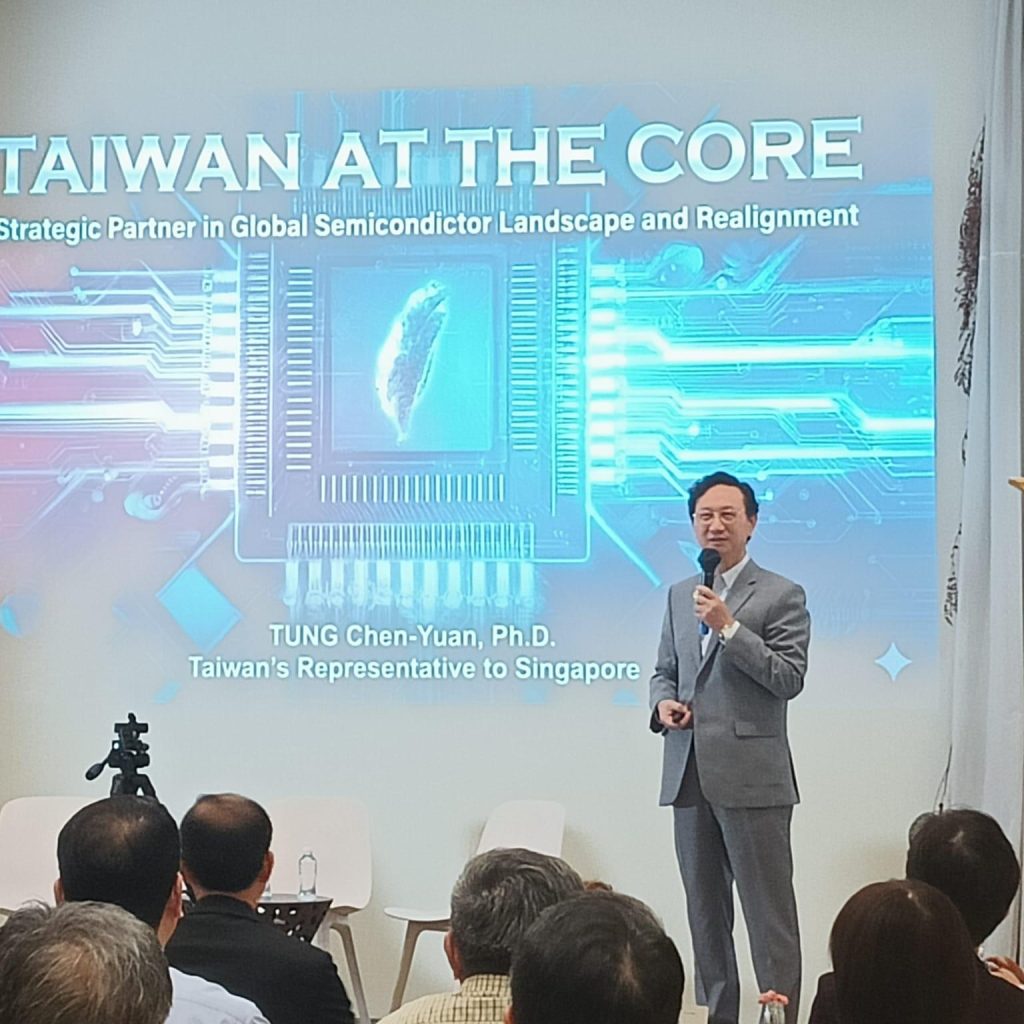
Yesterday, I was invited to deliver a lecture at the Society of Modern Management Singapore—my second invitation to speak there. Nearly 200 business leaders attended, and the exchange was vibrant. The lecture was centered on my new book, Taiwan at the Core, beginning with Taiwan’s central position in the global semiconductor supply chain, and extending to national policy strategies, the impact of geopolitical shifts on industry, and the new wave of industrial transformation driven by AI.
The audience’s questions were thoughtful and in-depth, covering investment cooperation, industry trends, and AI applications—reflecting the strong interest among Singapore’s business community in Taiwan’s technological capabilities and partnership potential.
Since the publication of the book last month, related exchanges have continued to expand in Singapore. We have hosted three semiconductor-focused sessions at my residence, targeting Taiwan semiconductor firms, international investors and multinational corporations, as well as local Taiwanese businesses and professionals. Several major Singaporean business associations have also invited me to speak, underscoring the high level of attention given to Taiwan’s technological role.
Over the past year, we have organized around 300 exchange events at my residence, with more than 4,000 participants. Moving forward, we will continue sharing developments in Taiwan’s high-tech industries with our Singaporean friends. At the same time, we are strengthening engagement with international media and think tanks. Recent discussions with correspondents from The Washington Post and Reuters aim to ensure that global discourse more accurately reflects Taiwan’s value in technology and geoeconomics.
In terms of industry research, we have continued publishing semiconductor reports in English. Since August 2023, 20 volumes have been released and made freely available online, attracting nearly 1,000 participants from global government, industry, academia, and media communities. These reports have also been widely shared, prompting proactive engagement from semiconductor associations in multiple countries—demonstrating Taiwan’s expanding influence.
In the field of AI, we have collaborated with the Global Alliance for Taiwan Technology and Diplomacy (GATTD) to publish a series of AI reports. Based in Silicon Valley and composed of Taiwanese tech professionals, the alliance aims to elevate Taiwan’s international standing through technology. Four reports have been released to date, covering AI safety, Singapore’s AI policies and industry development, and AI-based pricing model. Future initiatives will include collaboration with Taiwan’s academic community on the AI Basic Act, as well as partnerships with the Taiwan AI Academy to focus on talent development and emerging trends, further deepening international dialogue.
Taiwan–Singapore semiconductor cooperation is built on a long-standing and solid foundation. Since TSMC’s investment of 1.2 billion dollars in 1998, UMC invested 3.6 billion dollars in 2001 and an additional 5 billion dollars in 2022. By the end of 2024, Vanguard International Semiconductor and NXP established a joint venture worth 7.8 billion dollars. These investments have repeatedly ranked among the largest manufacturing projects in Singapore, highlighting the critical role of Taiwanese companies in the local industry.
Beyond wafer fabrication, Taiwan’s packaging, testing, and IC design companies have also actively expanded in Singapore. ASE and MediaTek each maintain R&D teams of several hundred personnel, while companies such as Realtek, Wah Lee, and Topco Scientific have long established a strong presence. Meanwhile, global industry leaders—including GlobalFoundries, Applied Materials, Lam Research, and Micron—have also set up operations in Singapore, making it a key hub in the global semiconductor supply chain.
Bilateral trade between Taiwan and Singapore is likewise highly concentrated in semiconductors. Last year, Taiwan became Singapore’s largest trading partner and source of imports for the first time. Approximately 85% of Taiwan’s exports to Singapore were semiconductor-related products, while about 80% of Singapore’s exports to Taiwan fell into the same category. In the first two months of 2025, Taiwan’s exports to Singapore grew by 56%, while Singapore’s semiconductor industry expanded by nearly 52%, demonstrating strong industrial linkage and mutual prosperity.
Looking ahead, we will continue leveraging tech diplomacy—integrating policy dialogue, industry exchange, and trend analysis—to drive deeper cooperation. In mid-April, I will lead a Singaporean business delegation to Taiwan to visit ITRI and the Hsinchu Science Park, further advancing bilateral collaboration in high-tech industries.
At the same time, we plan to update our semiconductor publications every two months, providing timely and systematic industry analysis to ensure Taiwan maintains a strong and consistent voice in global technology discussions.
Talent development is also a key pillar of tech diplomacy. Before arriving in Singapore, I engaged with presidents of several Taiwanese universities on semiconductor talent cultivation issues. Our office has compiled semiconductor course offerings from eight universities for reference by Singapore stakeholders, while also prioritizing Taiwan scholarships to encourage Singaporean students to pursue advanced studies in Taiwan.
This initiative has received strong support from the Singapore government, which arranged joint visits to four local universities for presentations. Talent remains a bottleneck for Singapore’s semiconductor industry and represents one of the most promising areas for deepened Taiwan–Singapore cooperation.
As the global technological landscape is rapidly reshaped, Taiwan is not only at the core of semiconductor manufacturing, but also a vital node connecting global innovation, talent cultivation, and industrial collaboration. Through tech diplomacy, we will continue to strengthen Taiwan’s international position in semiconductors and AI, while advancing a more comprehensive strategic partnership with Singapore.
About the Author:
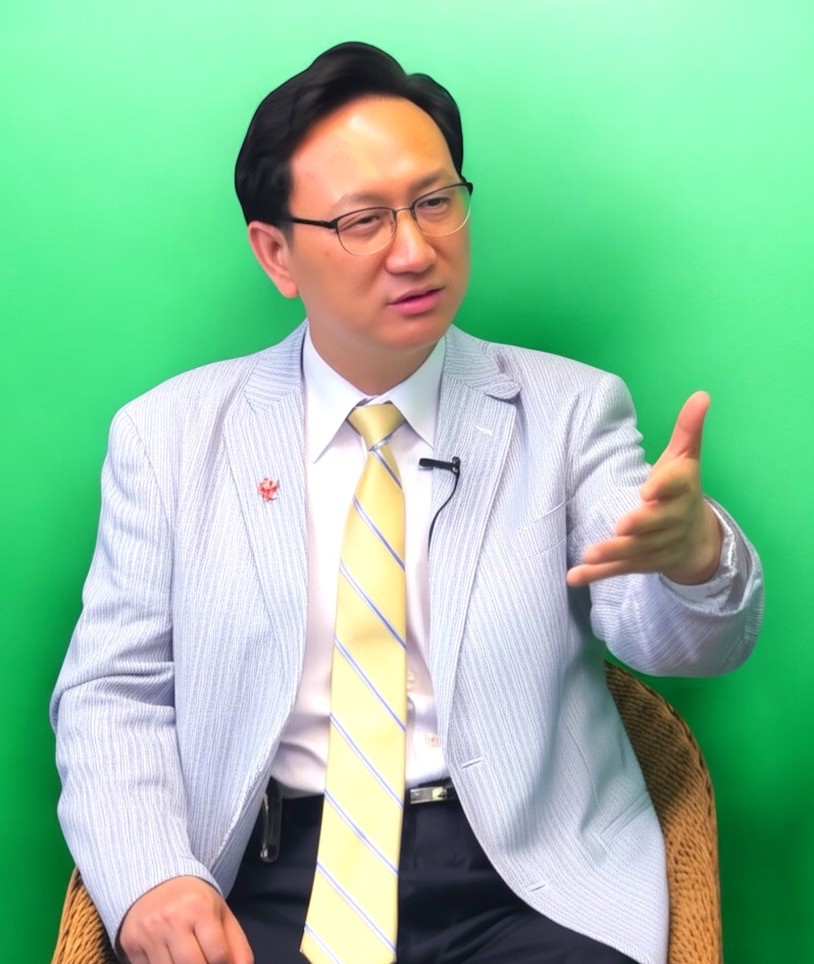
Dr. Tung Chen-Yuan is currently Taiwan’s Representative to Singapore. He was Minister of the Overseas Community Affairs Council of the Republic of China (Taiwan) from June 2020 till January 2023. He was Taiwan’s ambassador to Thailand from July 2017 until May 2020, senior advisor at the National Security Council from October 2016 until July 2017, and Spokesman of the Executive Yuan from May to September 2016. Before taking office, Dr. Tung was a distinguished professor at the Graduate Institute of Development Studies, National Chengchi University (Taiwan). He received his Ph.D. degree in international affairs from the School of Advanced International Studies (SAIS), Johns Hopkins University. From September 2006 to May 2008, he was vice chairman of the Mainland Affairs Council, Executive Yuan. His areas of expertise include international political economy, China’s economic development, and prediction markets.